By Daniel Kitts
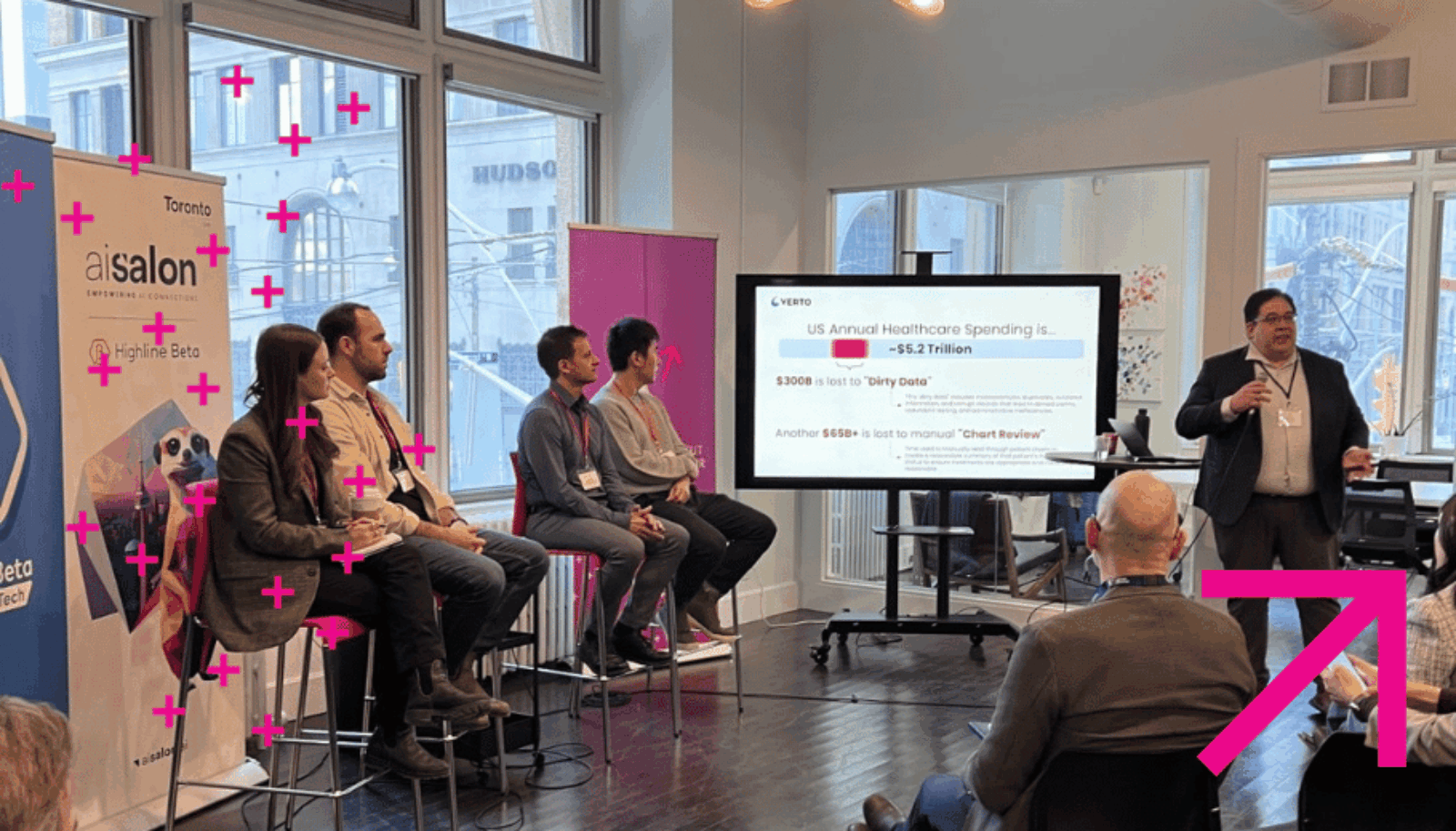
“Where were those 10 years ago in AI?” said Stephen Southin to the crowd at Vector’s first Demo Day. The AI industry veteran was energized after hearing pitches from several of the AI startups who had gathered for the January 20th event in Toronto.
“Well, Vector wasn’t around 10 years ago,” Fatima Khamitova, Director for Startups & Scaleups at the Vector Institute, replied with a smile.
Part of Vector’s FastLane program, which has helped more than 250 Canadian startups to accelerate their AI commercialization journey, Demo Day featured 12 companies pitching their products to four expert judges. They and other graduates of the FastLane program also had the opportunity to meet with the almost 30 venture capitalists (VCs) in attendance.
The event is a natural outgrowth of Vector’s unique model: Unlike other AI incubators and business accelerators, Vector assists startups without asking for an equity stake in return.
“Our mission goes beyond advancing the science of AI,” says Craig Stewart, Executive Director of Applied AI Programs at Vector. “It’s about ensuring Canadian innovators have a clear path from concept to commercialization. By connecting our brightest founders with the resources, talent, and capital they need, we are cultivating a vibrant ecosystem that will drive economic growth and solidify Canada’s position as a global AI leader.”
“If we’re helping startups build the best artificial intelligence products in the world, we also need to get them funded, otherwise all of these great ideas do not get built,” says Khamitova. “This is how Demo Day was born.”
Preparing startups for the next step
The companies represented at the first Demo Day offered a wide variety of potentially game-changing AI innovations:
Exhilarare
Lighthouse Energy
FluidMinds
A.I. VALI
Fawkes Biodata
Verto Health
Kiwi Charge
JVPLabs
BioBox
NeuraVue Ltd
Philer
Fenel
Exhilarare
Exhilarare wants to revolutionize advanced manufacturing by reducing production time from weeks to under two minutes

Lighthouse Energy
Lighthouse Energy is locating unused renewable energy to strengthen electricity grids, lower energy costs and reduce pollution

FluidMinds
FluidMinds is developing environmentally friendlier coolants and other new chemical compounds through AI and quantum chemistry

Fawkes Biodata
Fawkes Biodata collects your medical records, helps you find clinical trials, and answers health questions based on your history

Verto Health
Verto Health is creating detailed summaries of every patient in the health system to tackle administrative waste, delays, and improper treatments

Kiwi Charge
Kiwi Charge is developing an autonomous, mobile EV charger to make the charging experience more accessible and affordable
JVPLabs
JVPLabs has developed a non-invasive device to monitor the heart and significantly reduce the personal and medical costs of congestive heart failure
BioBox
BioBox wants to speed up and automate the decision-making process for new drug discoveries

NeuraVue Ltd
NeuraVue Ltd is developing real-time fall detection, distress recognition, wandering alerts, and physical abuse detection for seniors in care.

Philer
Philer offers a service that promises to make the often-frustrating process of real estate closings seamless.
Fenel
Fenel is trying to help people better capture, remember, and manage the many personal interactions they have every day in real life and on social media through agentic AI.
“I was really impressed with the presentations,” says Marcus Daniels, one of the Demo Day judges and the Founder & CEO of Highline Beta, a venture studio and VC firm that also hosted the event in their Toronto offices.
Daniels says that startup founders can often get too technical when pitching their ideas to VCs for the first time, but the Demo Day presentations were crisp and effective. He credits the FastLane program for helping the startups arrive at the event well-prepared.
“One of the challenges that Canadian AI startup founders have had historically is they sometimes haven’t been able to navigate the ecosystem,” he says. “Vector has really strong, structured programs and obviously a great track record of helping founders, bringing in investors and getting people ready.”
Armin Sedighian Rasouli, Founder & CEO of FluidMinds, agrees.
“The support that we got from the Vector crew throughout this on how to prepare our pitch and how to present it was so valuable,” he says. “It’s something that we could not get easily (elsewhere).”
“When you’re part of these programs, especially the Vector programs, people in the audience are open to your ideas of what you’re trying to build, and they want to support you,” says presenter Helen Kontozopoulos, Founder & CEO of Resiin. “It’s a great environment to express your ideas, express what you’re trying to build, and just have fun.”
And the support through Vector’s FastLane program extends beyond helping startups in the pitching process.
Chris Li, co-founder and CEO of BioBox, says there are a variety of unique and complicated challenges in developing a new AI technology that small startups have difficulty tackling on their own, such as ensuring proper governance, knowing how to validate the data the AI is generating, and setting proper benchmarks to measure progress.
“Working with Vector, it offered exposure to industry leaders, great AI scientists, great AI talent, and we continue to tap into those services today,” he says.
Connecting the best startups with the best investors
For a startup, finding the right investor not only provides much-needed funding, but also industry connections and expertise that can be instrumental in their success.
“It’s hard for us to approach VCs from all around the world,” says Arash Alborz, founder NUWAY, which develops AI-powered customer-support software. “But the Vector Institute brings the best of them, and we can talk easily with them like today. So that is amazing.”
Michael Millar, CEO of Verto Health, says that it is often difficult for investors who truly know the AI space to get connected with the AI startups that show the most promise. What makes an event such as Demo Day so useful, he says, is that Vector is able to do a kind of “two-ended vetting” that ensures the right investors are meeting startups with high potential.
“By acting as a third party – a credible third party – they just bring better quality people to the table,” he says.
“What Vector is doing is not very common,” says Kashif Chandani, Associate Director at TD Innovation Partners, which provides tailored banking, financing, and advisory services to technology companies and startups.
“They’ve kind of picked a very niche vertical and kind of really focused on that and bring in founders that can actually make a difference in the ecosystem,” he says.
Matt Morris, a VC with Hitachi Ventures who flew in from Boston to attend the event, was impressed that the companies weren’t just focused on what their AI systems do, but understood how it plays into the overall problem they are trying to solve.
“You can see that all the services started to at least tune towards, ‘What does the customer actually need? What is the problem actually that we’re solving?’ And then the solution is being built around solving that problem,” he says.
Strengthening the AI ecosystem
Beyond the presentations and the VC meetings, however, several startup founders said that the opportunity to meet other founders and discuss their work was a huge benefit in and of itself.
“I love to see how we continue to foster the collaboration between different entities in Canada,” says Kyle George, CEO and co-founder of Forged Operations, a company that produces AI to streamline operations and enhance safety in the nuclear industry. He says he met at least three companies that are working in roughly the same area as Forged Operations.
“I think we’re stronger together, especially from the startup ecosystem,” he says. “If we work together, we can have a bigger imprint on a global scale.”
“To meet with other founders that are building in the space, that creates a lot of opportunities of exciting conversations,” says BioBox’s Li. “The research collaborations, the notes around how to develop frontier AI technologies and platform and build great businesses, comes together at events like this, and it’s very valuable for the ecosystem.”
From innovation to adoption
Khamitova says that helping AI startups through Demo Day and the FastLane program is an incredibly rewarding part of Vector’s mission to help grow a Canadian AI ecosystem that not only produces groundbreaking research, but also successful companies.
“It’s been so exciting to have startups come to us about the problems that they’re having,” she says. “They say, ‘This is the grand, big idea that we have. We know that artificial intelligence can help, but how?’ And we give them the skills and the ability to execute those big ideas.”